


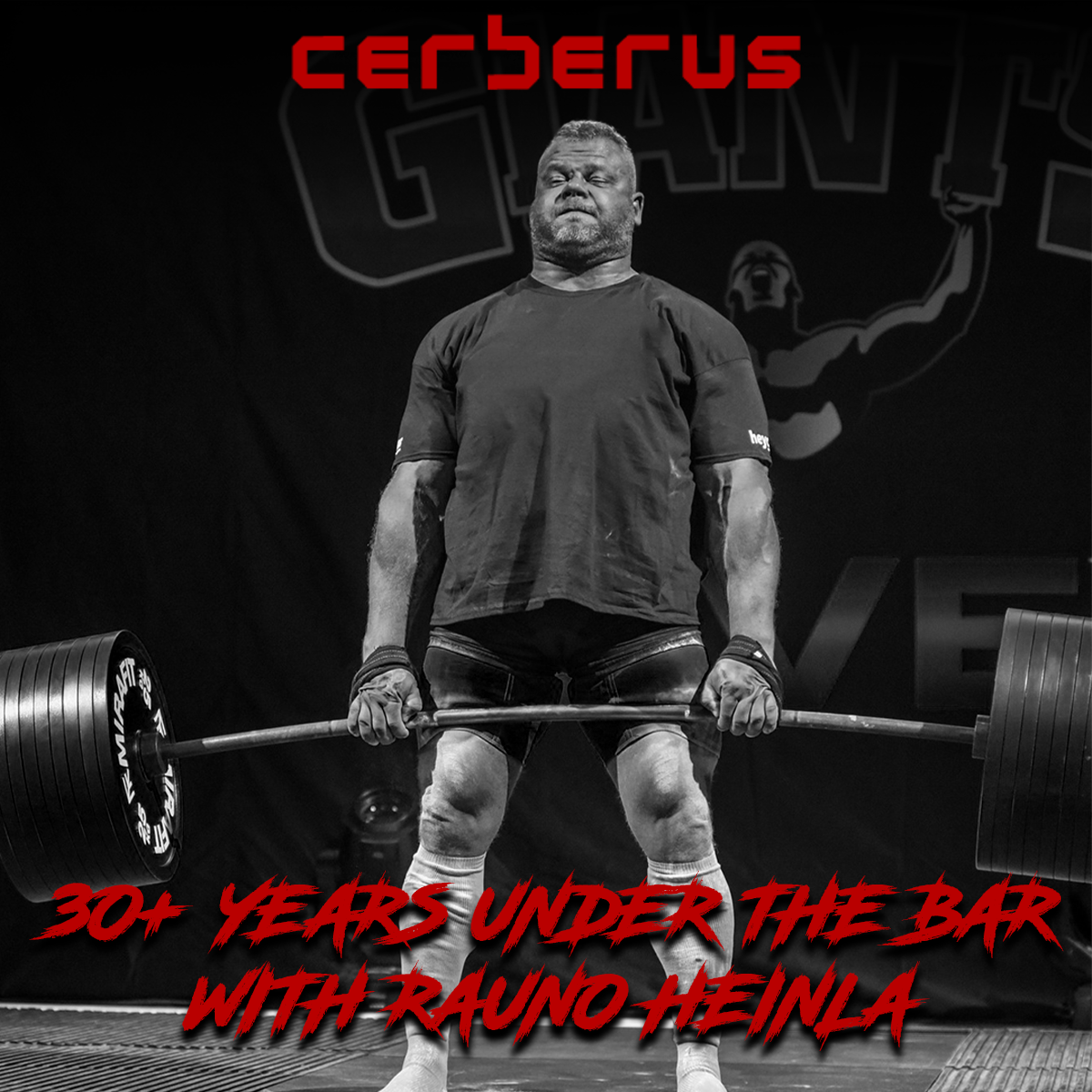
What a Lifetime of Deadlifting Has Taught Me From competing under 44 kg as a kid to chasing a 500+ kg deadlift
the lessons behind more than three decades of strength training.
Where It Started
I started lifting very young. My physical education teacher was involved in strongman and introduced us to lifting. Strength sports became part of my life almost immediately, and I was already competing as a child. Recently, I went through some of my old competition diplomas and realised just how small I actually was. At 13 years old, I was still competing in the under-44 kg bodyweight class. I don't even know exactly what I weighed at the time, but I was a very skinny kid. I competed in both Olympic weightlifting and powerlifting when I was young.
There were already competitions before my teenage years, and strength sport gradually became a serious part of my life. As my bodyweight increased, my deadlift developed quickly. At around 75 kg bodyweight, I was already deadlifting 250 kg. At 20 years old, weighing 87 kg, I pulled 290 kg. Later, in my early twenties, I pulled 310 kg sumo in training under IPF-style conditions. At 23, weighing around 112 kg, I pulled 345 kg for an Estonian record. Sumo was my main style when I was young. It was allowed in the competitions I was doing, and it suited me naturally. Later, strongman changed the direction of my deadlift career.
Becoming the First Estonian to Pull 400+ kg
My first 400+ kg deadlift was actually sumo. I was taking part in an Estonian television programme called Eesti Koige Koige. They asked me what I wanted to attempt, and I said we should try to make me the first Estonian to deadlift more than 400 kg. I pulled 402 kg. After that, my focus moved increasingly towards conventional deadlifting because of strongman. Over the years, the numbers continued to grow. I have pulled 420 kg raw in a commercial gym, where we even had to secure the plates so they would not fall off the bar.
Across my career, I have now pulled over 1,000 lb more than ten times in training and competition. But getting from 400 kg to the level where 450-470+ kg became repeatable taught me much more than simply adding weight to the bar.
My Biggest Mistake Held Me Back for Years
In 2015, I pulled 440 kg in training. At the Giants Live World Deadlift Championships, I pulled 435 kg very easily, but tore my hamstring attempting 450 kg. For several years after that, my deadlift stayed around the same level. Eventually, I understood one of the biggest mistakes I had made throughout the earlier part of my career: I wasn't giving my hamstrings enough direct attention. I had also suffered too many hamstring injuries. When I finally made hamstring development a serious priority, things started to change. From around 2019 onwards, my deadlift began moving noticeably again.
I started training my hamstrings twice per week - after deadlifting and again around my squat or leg training. Before heavy training, I also started paying more attention to warming up the hamstrings, mobility and a small amount of controlled stretching. The strength work itself was not light rehabilitation Rauno Heinla - 30+ Years Under the Bar 4 work. I trained the muscles hard. One unusual hamstring exercise that worked particularly well for me involved lying face down with a large exercise ball placed on my back.
From that position, I would rapidly drive my legs back against a padded beam, repeatedly contracting the hamstrings until they were completely pumped and fatigued. It was simple, but extremely effective. I also used machine-based hamstring exercises with genuinely heavy resistance - not just light accessory work. That period changed how I thought about deadlift training. If a muscle is repeatedly your weak link, hoping that the main lift alone will eventually fix it isn't always enough. Sometimes you need to attack the weakness directly.
Why I Believe So Strongly in Block Pulls
If there is one thing that has separated my deadlift training from many other strongmen, it is probably how much attention I have given to finishing the lift. I have done a huge amount of pulling from blocks, particularly from just below the knee, and very often using a stiff bar. Everything that gets above my knees gets finished. A strong lockout is not something I leave to chance. But block pulls have another important purpose. They are an excellent way to strengthen and learn to maintain the correct back and body position. A common mistake is easy to see when the bar leaves the floor.
The hips shoot up too early, the athlete loses the position and then has to try to finish the lift mainly with the back. Starting from a higher position reduces the amount of leg drive available. That is not a disadvantage - it is part of what makes the variation useful. From the blocks, I can concentrate on maintaining a strong back position and building strength through the second half of the deadlift. Once that position becomes stronger and more natural, the starting height can gradually be lowered. The goal is to maintain that same strong position as the bar gets closer to the floor.
For me, block pulls have never been only about overloading the bar. They are about making the position strong enough that when a maximal deadlift gets above my knees, I know I can finish it.
Keep the Bar Close
There is another simple technical principle I take very seriously: the bar needs to stay close to the body. It should travel along the shins and legs rather than moving out in front. After a serious deadlift session, it is completely normal for the front of my legs to be scraped and marked from the bar. The marks themselves are obviously not the objective. They are simply a consequence of keeping the bar where I want it. Every centimetre the bar moves away from your body creates a worse mechanical position. With normal training weights, you might get away with it.
At maximal weights, small technical mistakes become big mistakes.
One of My Best Builders: Snatch-Grip Deadlift
Another exercise I rate extremely highly is the snatch-grip deadlift. I use a normal bar rather than a longer deadlift bar because the shorter bar allows me to take my grip almost completely out towards the ends. I have done 300 kg for 10 reps from the floor with a maximum-width snatch grip, using straps. The tension and stretch you create through that position is enormous. For me, it has been one of the best exercises for building strength from the starting position and developing the back. When grip isn't the purpose of the session, I normally use straps on the final working sets.
There is no reason to allow grip to limit the muscles I am actually trying to train. If I were preparing for an IPF-style competition or another situation where grip itself mattered, then obviously grip would need specific training as well. Training always has to match the goal.
Stop Testing Your Maximum in Training
One of the biggest mistakes I see is too much heavy training combined with poor technique. A programme needs structure. For deadlift, I generally like approximately seven days between serious pulling sessions. For an advanced athlete approaching competition, that can sometimes increase to around ten days. That does not mean the legs only get trained once every seven or ten days. I still believe the legs should receive work twice per week. The deadlift session can be one of those sessions, with another dedicated leg session during the week. One progression I have used is very simple.
I might start at approximately 80% and use the same working weight across three weeks: Week 1 - 4 x 1 Week 2 - 3 x 2 Week 3 - 3 x 3 Then I take a recovery period. After that, we increase the weight and begin another progression. The exact percentages and weights depend on the athlete, but the principle is what matters. There needs to be progression, but there also needs to be recovery. After approximately three hard weeks, I like having a recovery week before pushing again. And I almost never see a reason to pull a true 100% maximum in the gym. For me, RPE 9-9.5 is enough.
If my target is a 500 kg deadlift and I can make 460 kg look easy in training, that tells me what I need to know. I would rather carry that strength and confidence into competition than prove something unnecessary in the gym. The competition is where the maximum matters.
Ten Minutes Between Heavy Sets Is Normal
Heavy deadlifting is not conditioning. When the weights become very serious, I have no problem resting around 10 minutes between heavy working sets. Sometimes I start a session and immediately feel that today might not be the day. But I don't judge the entire session from the first warm-up. The weight increases, concentration increases, the body switches on and sometimes the heavier weights actually begin to move better. I have experienced this many times. Serious strength training requires the ability to switch yourself on when the weight demands it.
But experience also means knowing the difference between a day where you simply need to wake yourself up and a day where your body is genuinely warning you that something is wrong.
Strongman Programming Has to Respect Recovery
This becomes even more important for strongman athletes. You cannot treat deadlift, squat and every strongman event as completely separate sports and try to maximise all of them simultaneously. Everything affects everything else. You need to decide where the strongman sessions go, where the heavy deadlift goes and how much recovery exists between them. A powerful deadlift also transfers extremely well to strongman. Atlas stones are a good example. When maximum stone weight has been the event, my pulling strength has always given me an advantage.
But strength only helps if you arrive at competition capable of using it. More training is not automatically better training.
The Deadlift Suit Is a Tool - If You Know How to Use It
I have experimented with a lot of deadlift suits throughout my career. At times I have had five different suits available. I have even had three different sizes from the same manufacturer because I wanted to understand exactly which one gave me the best result. The suit that works perfectly for one athlete may not work for another. One of the biggest mistakes I see in equipped maximal deadlifting is athletes not taking full advantage of their suit. They wear it too loose. Even extremely strong lifters can leave kilos on the platform because they are not getting enough tension from the suit.
In my experience, a correctly selected and correctly fitted deadlift suit can give 40 kg or more. But getting that benefit is not comfortable. My way of describing the correct tension is simple. When I reach down and take the bar with one hand, breathing should already become difficult. If I can get both hands onto the bar and still breathe completely normally, then for me the suit is probably not tight enough to give its maximum benefit. There is obviously a balance.
The suit needs enough tension to help you, but you still need to be capable of reaching the bar, establishing the correct position and actually completing the lift. That requires practice. You cannot simply put a tight suit on for the first time on competition day and expect 40 kg.
470 kg Conventional - Then 475 kg Sumo
One of my favourite examples of how naturally sumo has always worked for me came around Christmas 2020. I pulled 470 kg conventional in training using a single-ply suit. One week later, I changed to sumo. I had not seriously trained sumo for approximately 11 years. I pulled 475 kg. Years later, before competing in Germany, I also pulled 450 kg raw sumo in training. My conventional training numbers have included 460 kg for two reps, as well as 400 kg for six touch-and-go reps without a suit.
In competition, I have pulled 400 kg for six reps as well, although I believe I had more strength available when I did the training set. I have also pulled 580 kg in the Silver Dollar Deadlift and 540 kg from 18 inches. Different deadlift variations demand different strengths, but all of them have contributed to my understanding of pulling.
476 kg - And I Still Don't Believe It Was My Maximum
In 2022, I pulled 476 kg for the Masters world record. It moved extremely well. At that stage I was using a single-ply suit. Later, I moved to double-ply suits and reached a point where 470 kg could move very easily. That is one reason I still don't believe I have demonstrated my absolute maximum deadlift. Las Vegas is probably the best example. Before the competition, I made a mistake. I spent too much time walking around the city. The day before competing I did approximately 10,000 steps. That is completely unnecessary before attempting one of the biggest deadlifts of your life. I also lost too much fluid.
At the competition, 470 kg moved better than it ever had for me. My confidence going into 505 kg was extremely high. I believe the strength was there. But during the 505 kg attempt, I felt and heard something go in my hamstring. When that happens under a weight like 505 kg, your reaction is automatic. I put the bar down. That experience reinforced something very simple that I now tell athletes: arrive hydrated. And hydration is not only about drinking plain water. Before a major competition, I pay attention to salts, electrolytes and minerals as well.
You can spend months building strength and then compromise the result during the final 24 hours by doing something completely unnecessary. I have made that mistake myself.
What Hamstring Injuries Have Taught Me
I have had many injuries during a very long career. I have also competed surprisingly soon after some significant hamstring injuries. My approach has never been to simply lie still and hope the muscle repairs itself. Depending on the injury and professional assessment, I have used treatment alongside controlled movement, resistance-band exercises and cycling to maintain movement and circulation during rehabilitation. I have also used cold treatment immediately after some injuries and elevation during the early stage. In my own case, I have used platelet-rich plasma (PRP) injections as part of treatment.
There have been situations where I received several treatments over approximately two weeks and was able to return to competition very quickly. In 2023, for example, I competed at Giants Live only eight days after a significant hamstring injury and pulled 425 kg. I deliberately did not go heavier. On another occasion, I suffered a hamstring injury around two weeks before Dubai and still pulled 450 kg with Rauno Heinla - 30+ Years Under the Bar 9 weight in reserve. I have had other similar situations during my career. But this is important: those are my experiences, not a recommendation that everyone should compete two weeks after a hamstring tear.
The severity and location of the injury matter. The athlete matters. Professional assessment matters. Treatment matters. What my experience has taught me is that rehabilitation needs to be treated with the same seriousness as training.
Recovery Is Part of Training
Coming from Estonia, sauna has always been one of the most normal traditional recovery methods around me. But today my approach goes much further. If you have access to a good physiotherapist who actually understands strength sport and can regularly work on muscular tension, mobility and recovery, I believe that is a major advantage. I didn't have this level of physiotherapy throughout most of my career. Now I do. And it has changed the way I look at preparation. At a high level, the question isn't only: How much training can I do? It is also: How much quality training can my body recover from?
Those are two very different questions.
At 45, I Am Trying Something Completely Different
After more than three decades of training, my body is obviously not the same body I had at 20, 25 or 30. Today I have significant wear in my knees. That means I cannot simply rely on maximal squats and full strongman training in the same way I did earlier in my career. For most of my career, I strongly believed in squatting alongside deadlifting. When my deadlift was at its strongest, my squat strength was normally high as well. Now we have had to find another approach. And that is exactly what makes my current preparation interesting to me.
We are spending approximately 15 months trying something I have never tried before. I travel to Germany twice per month to train at Sportschule Kinema. The preparation includes much more physiotherapy, more management of muscular tension and a different approach to maintaining and building the strength I need without relying on the same maximal squatting and full strongman workload that I used earlier in my career. For the first time in my life, physiotherapy is a major and consistent part of a long competition preparation. I don't know yet exactly where this approach will take me. That is why we are doing it.
After more than 30 years, I am still learning. And to me, that is what experience actually means. Experience isn't doing the same programme for 30 years because it worked once. Experience is understanding why something worked, recognising when your circumstances have changed and finding another way to create the same result.
One More World Record - And One Number I Still Want
The target is July 2027 in Germany at the Eisenhart Games. I am preparing for it seriously and travelling to Germany twice per month as part of that preparation. There are two numbers in my head. The first is 480 kg. That is my target for a new Masters deadlift world record. The second number is different. It is personal: 500+ kg. Before I finish my professional strongman career, my dream is to deadlift more than 500 kg. I have been lifting since I was a small kid competing in the under-44 kg class. At around 75 kg bodyweight, I pulled 250 kg. At 20 years old and 87 kg, I pulled 290 kg.
Eventually came 402 kg, then 440 kg, then the 450+ kg lifts. I have pulled over 1,000 lb more than ten times in training and competition. I have pulled 460 kg for two. I have pulled 470 kg conventional. I have pulled 475 kg sumo. I have pulled 476 kg for a Masters world record. I have pulled 400 kg for six reps. I have pulled 540 kg from 18 inches. I have pulled 580 kg in the Silver Dollar Deadlift. But I still don't believe I have shown my absolute maximum. At this stage of my career, getting stronger is no longer about simply doing more. I have to be smarter with training. I have to manage recovery.
I have to keep my hamstrings strong. I have to work around the limitations my body has accumulated after decades of strength sport. And I have to arrive on the right day healthy enough to use all the strength we have built. More than 30 years under the bar has taught me one thing above everything else: Build the strength. Build the technique. Take recovery as seriously as training. Stay healthy enough to use what you have built. And when the bar gets above the knees: finish the lift.